

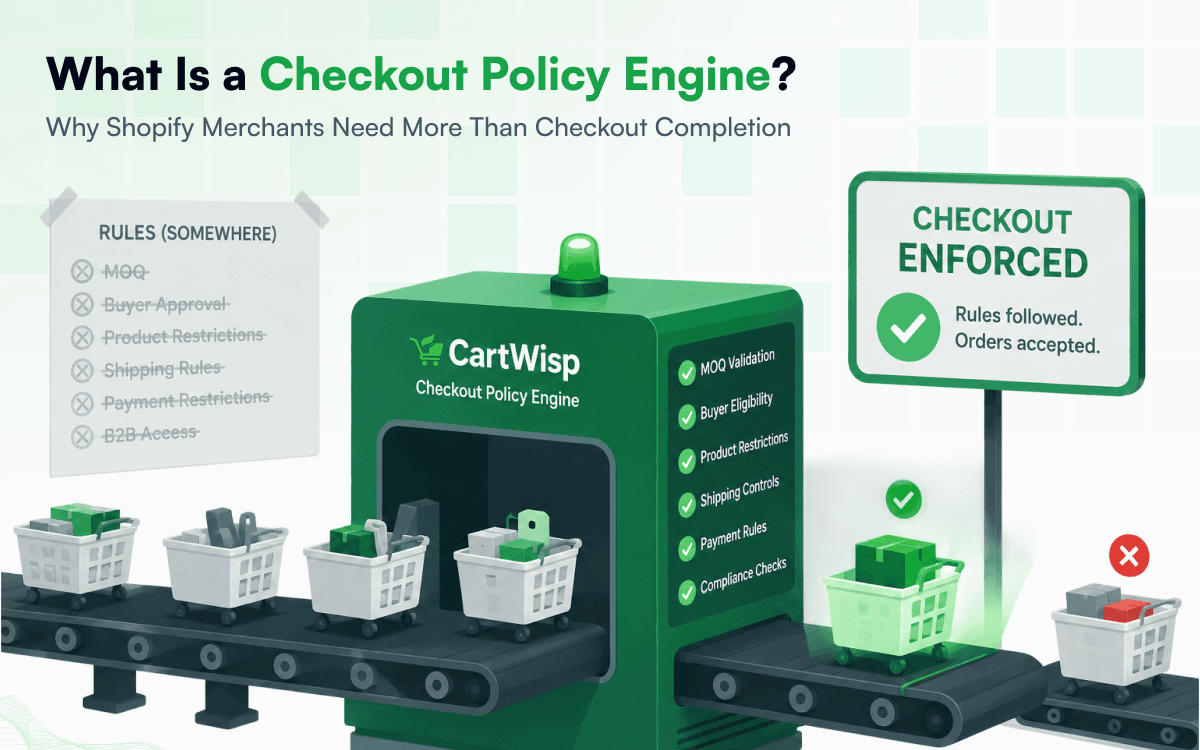
Every Shopify merchant wants checkout to be smooth. But for wholesalers, distributors, B2B merchants, regulated sellers, and operations-heavy stores, smooth checkout alone is not enough. The bigger question is not only whether the customer can complete payment. The bigger question is whether the order should be accepted at all.
A customer may be able to complete checkout, but the order may still violate your store policies, B2B rules, shipping limitations, payment restrictions, or compliance requirements.
That is why growing merchants need more than checkout completion. They need checkout policy enforcement.
Shopify Checkout Is Built to Complete Orders
Shopify checkout is designed to help customers complete purchases efficiently. That is important for conversion.
But many growing merchants have rules that go beyond simple checkout completion.
For example:
- Wholesale buyers must meet minimum order quantity
- Distributors must be approved before placing certain orders
- B2B customers may need to meet minimum order value
- Retail customers should not access wholesale-only products
- Some products cannot ship to specific states, countries, or regions
- Freight-only products require specific shipping methods
- COD or BNPL may not be allowed for high-risk orders
- Certain products should not be purchased together
- Some products require buyer verification before purchase
These are not just store preferences. They are business policies.
And if those policies are not enforced before checkout is completed, invalid orders can still enter your system.
The Gap Between Store Policy and Checkout Behavior
Many Shopify merchants already have policies in place.
They may publish them on product pages, wholesale pages, shipping policy pages, customer account pages, or internal SOPs. But a written policy is not the same as an enforced policy.
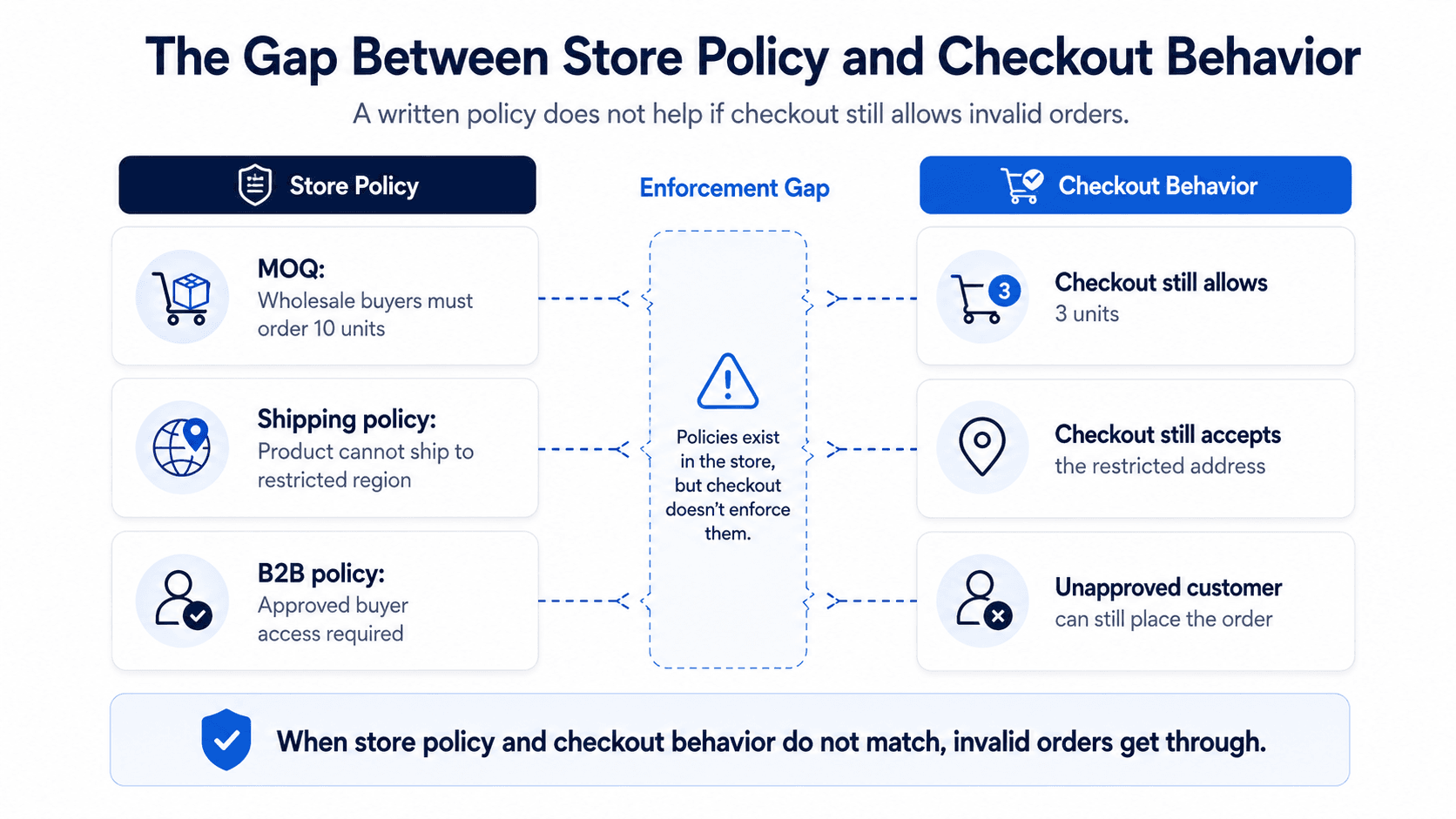
- A product page may say that wholesale buyers must order at least 10 units. But if checkout allows a buyer to place an order for 3 units, the policy was not enforced.
- A shipping policy may say that a product cannot ship to a certain region. But if the customer can still complete checkout with that address, the restriction was not enforced.
- A B2B program may require approved buyer access. But if an unapproved customer can still place the order, the buyer policy was not enforced.
This creates a gap between what the store says and what checkout allows. That gap creates invalid orders.
Why Suggested Rules Are Not Enough
Some merchants try to manage checkout rules with warnings, popups, product notes, theme edits, or manual review.
These methods may help communicate policies, but they often fail to enforce them.
- A customer may ignore a warning.
- A popup may appear too early or too late.
- A product note may be missed.
- A theme script may not cover every checkout scenario.
- A manual review process only catches the issue after the order has already been placed.
For simple stores, this might be manageable. For wholesalers, distributors, and B2B merchants, it quickly becomes a scaling problem.
If your store depends on MOQ, approved buyer access, shipping restrictions, or payment controls, then your policies should not be suggestions. They should be enforced at checkout.
What Is a Checkout Policy Engine?
A checkout policy engine is a system that validates orders against the merchant’s rules before the order is placed.
It helps checkout answer more than: “Can this customer pay?” It helps checkout answer: “Does this order follow our store policy?”
A checkout policy engine can evaluate conditions such as:
- Cart value
- Product quantity
- Customer eligibility
- Buyer approval
- Customer tags
- Product restrictions
- Shipping address
- Shipping region
- Shipping method
- Payment method
- Product combinations
- B2B checkout requirements
- Compliance rules
If the order does not meet the required policy, checkout can be blocked, restricted, or guided with a clear message before the order is created.
This is the difference between a checkout that only completes transactions and a checkout that enforces business rules.
Why Wholesalers and Distributors Need Checkout Policy Enforcement
Wholesalers and distributors often have stricter order requirements than standard retail stores.
They may need to enforce:
- Minimum order quantity
- Minimum order value
- Case-pack ordering
- Approved buyer access
- Wholesale-only product access
- Distributor-specific purchasing rules
- Company-based restrictions
- Invoice or net-term payment eligibility
- Bulk shipping conditions
If these rules are not enforced at checkout, invalid B2B orders reach the operations team. That creates manual review, customer follow-up, order edits, cancellations, and inconsistent exceptions. For a distributor, even one small invalid order can create unnecessary work. For a growing B2B store, repeated invalid orders create operational drag.
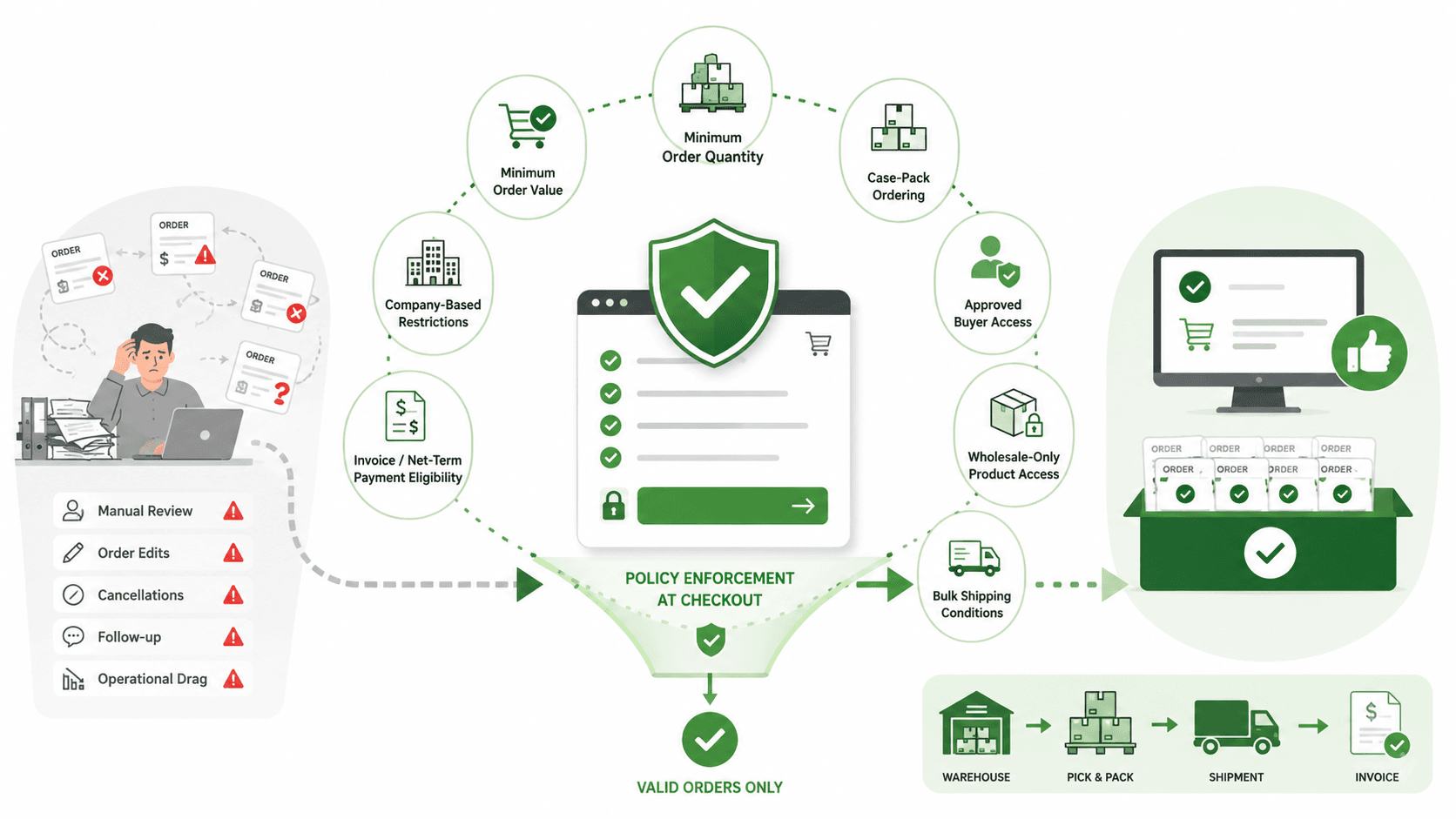
Checkout policy enforcement helps keep B2B order intake cleaner from the start.
Why Rules Should Be Enforced, Not Suggested
There is a major difference between telling customers what your policy is and preventing orders that violate it.
For example, a product page may say: “Wholesale buyers must order at least 10 units.”
But if checkout allows 3 units, your store is still accepting the wrong order. An enforced rule would stop checkout and show a clear message:
“Wholesale orders require a minimum quantity of 10 units. Please update your cart to continue.”
That is stronger than a note. It is clearer than manual review. It prevents the problem before it reaches fulfillment. The same applies to shipping rules, payment rules, buyer eligibility, product restrictions, and compliance requirements.
Rules that matter should be enforced where the order is created.
Introducing CartWisp: The Checkout Policy Engine Built for Shopify
CartWisp is built to help Shopify merchants enforce checkout rules before invalid orders are placed.
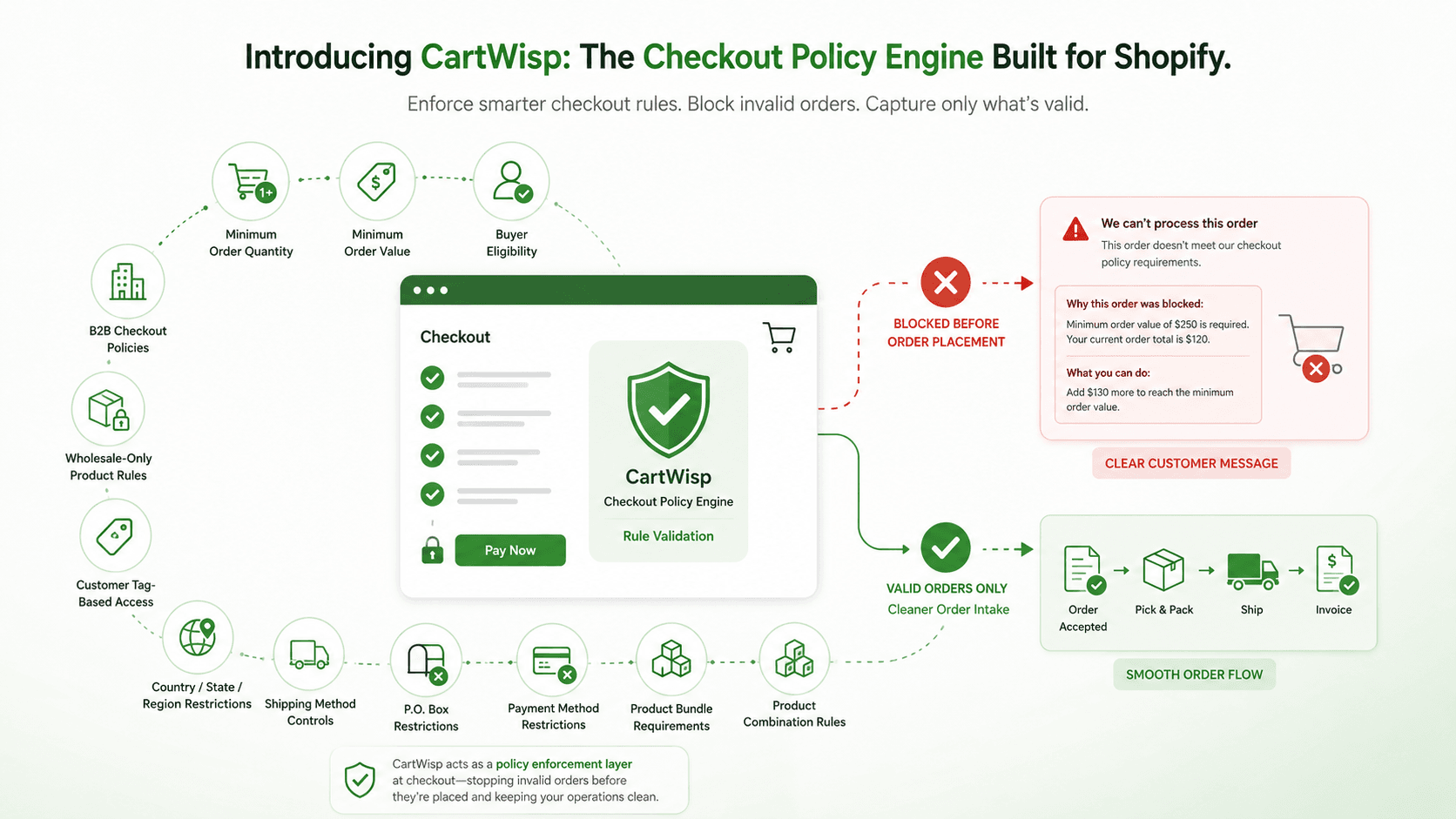
It acts as a policy enforcement layer for Shopify checkout, helping merchants validate order conditions such as cart value, MOQ, buyer eligibility, product restrictions, shipping methods, payment methods, and compliance rules.
With CartWisp, merchants can create checkout rules for:
- Minimum order quantity
- Minimum order value
- Buyer eligibility
- B2B checkout policies
- Wholesale-only product rules
- Customer tag-based access
- Country, state, and region restrictions
- Shipping method controls
- P.O. Box restrictions
- Payment method restrictions
- Product bundle requirements
- Product combination rules
- Customer verification workflows
If a customer attempts to place an order that violates a configured rule, CartWisp can help stop the order before it is placed and show a clear message explaining what needs to be fixed.
Example: Checkout Policy for a Distributor
A distributor sells products in case packs and requires approved wholesale buyers to order at least 12 units. Without checkout enforcement, a buyer may place an order for 4 units.
The order enters the system. Then the team has to review it, contact the buyer, request changes, or cancel the order.
With CartWisp, the distributor can enforce a checkout rule before order placement.
If the buyer does not meet the required quantity, checkout can be blocked with a message such as:
“Distributor orders require a minimum quantity of 12 units. Please update your cart to continue.”
The buyer gets clear guidance, and the invalid order never reaches operations.
Example: Checkout Policy for Shipping Control
A merchant sells oversized products that require freight shipping. Without enforcement, customers may select a standard shipping method that the fulfillment team cannot support.
That creates delays, shipping corrections, and customer follow-up.
With CartWisp, the merchant can enforce shipping rules that prevent unsupported shipping choices before checkout is completed.
This keeps checkout aligned with actual fulfillment capabilities.
Example: Checkout Policy for Payment Control
A B2B merchant may only want to offer invoice payment to approved customers. Without enforcement, the wrong customer may access a payment method that should not be available.
With CartWisp, payment options can be controlled based on buyer eligibility, order value, product type, or other checkout conditions.
This helps reduce payment risk and keeps checkout aligned with business rules.
From Checkout Completion to Checkout Control
For simple stores, checkout completion may be enough. For growing Shopify merchants, checkout needs to do more.
It needs to validate whether the order is operationally acceptable, commercially valid, compliant, and fulfillable.
That is the role of a checkout policy engine.
It helps merchants move from:
Written policies to enforced rules Manual review to automatic validation Post-purchase fixes to pre-checkout prevention Checkout confusion to checkout control CartWisp is built for this shift.
Stop Letting Checkout Accept Orders That Break Your Rules
If your store has MOQ rules, buyer eligibility rules, shipping restrictions, payment conditions, product limitations, or compliance policies, those rules should not depend on customer memory or team review.
They should be enforced before the order is placed.
CartWisp helps Shopify merchants turn checkout into a policy engine, so invalid, non-compliant, and unfulfillable orders can be stopped before they become operational problems.
Book a Demo to see it in action: https://cartwisp.com/demo
Enforce your checkout rules before orders are placed.
Install CartWisp Now: https://apps.shopify.com/cartwisp
#CartWisp #CheckoutValidation #CartValidation #CheckoutControl #CheckoutRules #CheckoutPolicy #CheckoutGovernance #InvalidOrders #OrderValidation #PolicyEnforcement #ShopifyCheckout #ShopifyCheckoutRules #WholesaleEcommerce #ShopifyB2B