

Some Shopify orders look correct at checkout but create problems during fulfillment.
For wholesalers, distributors, B2B merchants, and stores with complex products, not every product should be purchased alone. Some products require accessories. Some bundles must be complete. Some products should not be purchased together. Some subscription and one-time items may need to stay separate.
If checkout does not validate these rules, your team finds the issue after the order is already placed.
The Problem
Many Shopify merchants rely on product descriptions, cart notes, or manual review to manage product rules. But customers can still complete checkout with an incomplete or invalid cart.
Common examples include:
- A required accessory is missing
- A warranty or installation kit is not added
- A B2B bundle is incomplete
- Subscription and one-time products are mixed
- Incompatible products are purchased together
- Restricted products are combined with items that create shipping or compliance issues
The order is placed first. Then operations or fulfillment has to fix it later.
Why It Happens
Shopify checkout is designed to complete the order. But product rules often depend on business context.
- A product may need another item to be usable.
- A wholesale kit may need all required components.
- A product pairing may create fulfillment issues.
- A subscription item may need a separate checkout flow.
If these rules are only explained on product pages, customers may miss them. If they are only checked manually, the issue is caught too late.
The Consequences
Incomplete or invalid product combinations create extra work. Your team may need to:
- Contact the customer
- Edit the order
- Ask the buyer to place another order
- Delay fulfillment
- Cancel or refund the order
- Handle support tickets
- Manually correct warehouse instructions
This creates friction for both the merchant and the customer.
A customer should not receive confirmation for an order that cannot be fulfilled correctly.
The Better Approach
Product rules should be enforced before checkout completes.
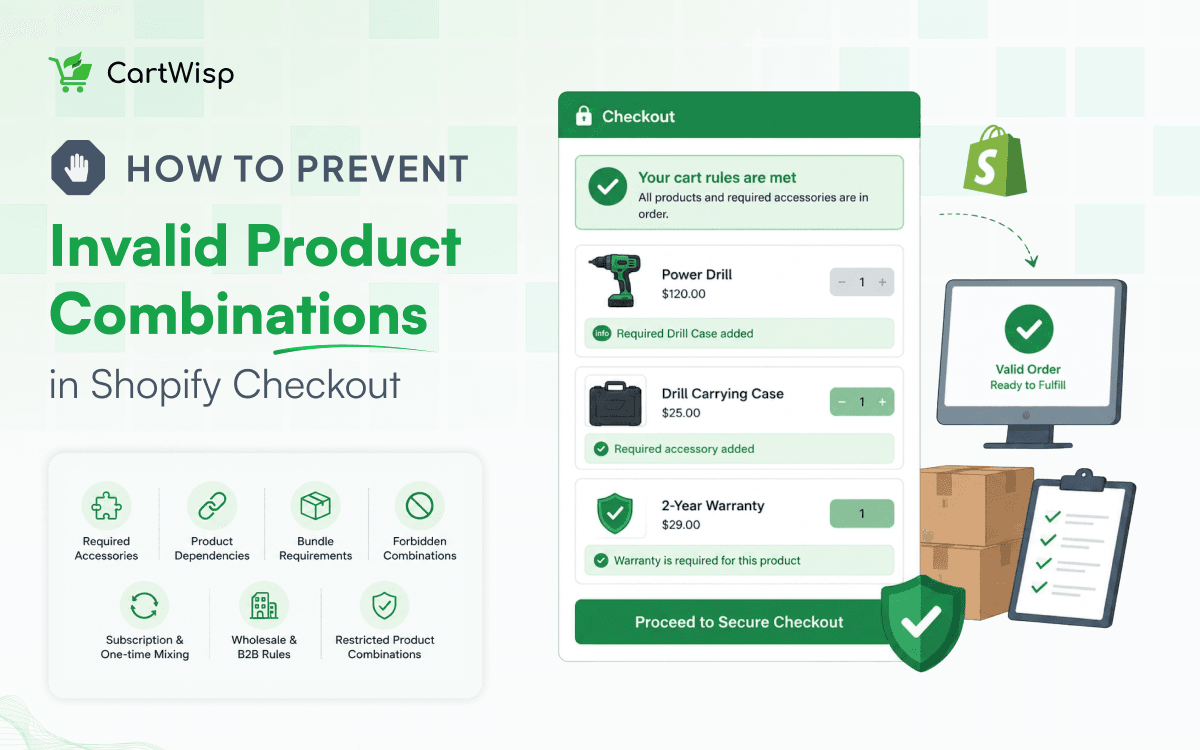
- If a product requires an accessory, checkout should require it.
- If a bundle is incomplete, checkout should guide the buyer to add the missing item.
- If two products should not be purchased together, checkout should block the order.
- If subscription and one-time products should not mix, checkout should enforce that rule.
This keeps invalid carts from becoming operational problems.
How CartWisp Helps
CartWisp helps Shopify merchants enforce checkout rules before orders are placed.
For product and bundle workflows, CartWisp can help control:
- Required accessories
- Required bundle items
- Product dependencies
- Forbidden product combinations
- Subscription and one-time product mixing
- Wholesale product rules
- B2B kit requirements
- Restricted product combinations
If the cart violates a rule, checkout can show a clear message before the order is placed.
Example:
“This product requires a compatible accessory. Please add the required item to continue.”
Or:
“These products cannot be purchased together. Please update your cart to proceed.”
That is better than accepting the order first and fixing it later.
Final Thought
If your team is still correcting incomplete product combinations after checkout, the problem is not only fulfillment. It is checkout validation.
CartWisp helps Shopify merchants enforce product and bundle rules before invalid orders are placed.
Book a Demo to see it in action: https://cartwisp.com/demo
Install CartWisp on Shopify: https://apps.shopify.com/cartwisp
#CheckoutValidation #CheckoutControl #CheckoutRules #CheckoutPolicy #CheckoutGovernance #InvalidOrders #OrderValidation #PolicyEnforcement #ShopifyCheckout #ShopifyCheckoutRules #WholesaleEcommerce #ShopifyB2B