

Every Shopify merchant has store policies that protect their operations, margins, customers, and compliance requirements. For wholesalers and distributors, those policies may include minimum order quantity, minimum order value, approved buyer access, and B2B purchasing rules. For regulated or freight-heavy merchants, they may include shipping restrictions, region-based product rules, payment controls, and customer eligibility checks.
But if checkout still allows customers to place orders that violate those policies, the problem does not disappear — it simply becomes a manual issue your team has to fix after the order is placed.
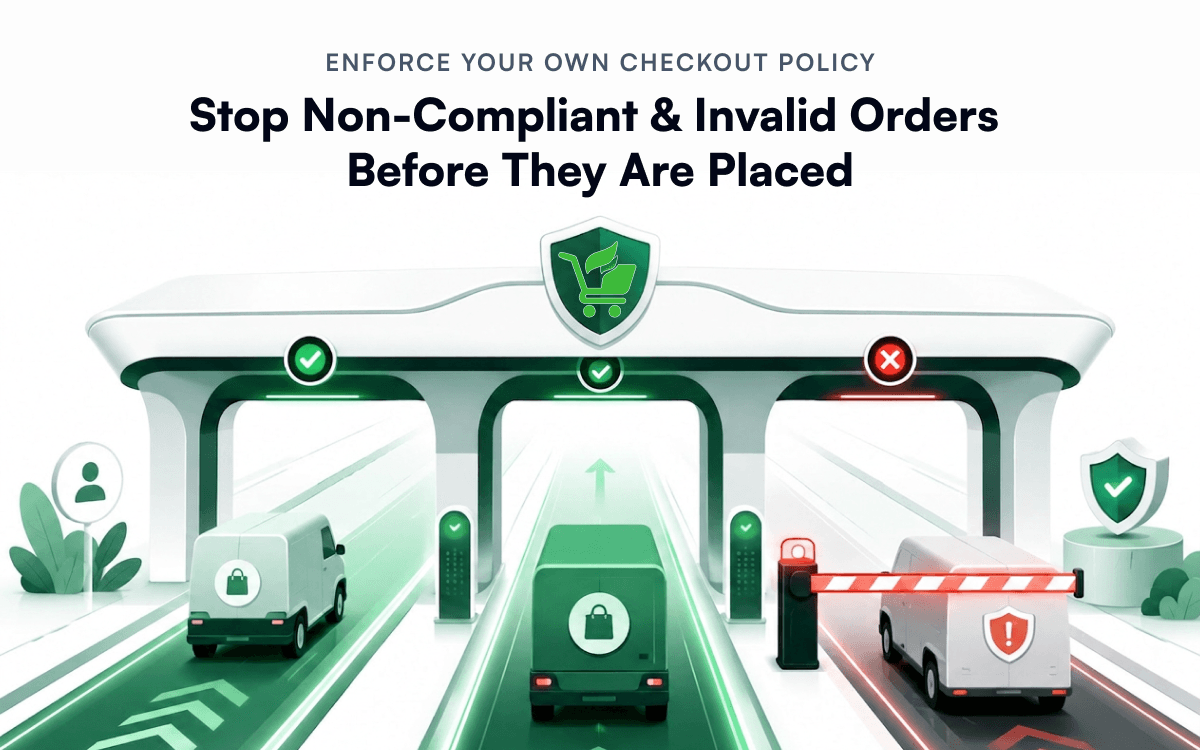
Your Store Policies Should Not Be Optional at Checkout
Every growing Shopify store has policies that exist for a reason.
- A wholesale store may require buyers to meet MOQ or minimum order value.
- A distributor may only allow approved customers to purchase certain products.
- A regulated product seller may need age, region, or buyer qualification checks.
- A freight-heavy store may need to prevent unsupported shipping methods.
- A high-risk order may require specific payment controls.
These are not just preferences. They are business rules that protect your operations, margins, fulfillment workflow, and compliance position.
But when those rules are not enforced during checkout, invalid orders can still be placed. That means the order reaches your team first, and the problem gets solved later.
The Real Cost of Orders That Violate Store Policy
When a customer places an order that breaks your store policy, the damage does not stop at checkout.
Your team may need to:
- Review the order manually
- Contact the customer
- Explain why the order cannot proceed
- Ask the buyer to modify the order
- Cancel or refund the order
- Change shipping instructions
- Block fulfillment
- Escalate compliance concerns
- Handle support tickets
For a single order, this may feel manageable. But for wholesalers, distributors, B2B merchants, regulated sellers, and high-volume Shopify stores, these exceptions quickly become expensive.
Every invalid order creates operational drag. And worse, the customer may already believe the order was accepted.
Common Store Policy Violations Shopify Merchants Face
Many invalid orders happen because checkout completes the transaction without validating the full business context.
Common examples include:
- A wholesale buyer places an order below MOQ
- A distributor places an order below minimum order value
- A retail customer accesses wholesale-only products
- An unapproved buyer purchases restricted items
- A product is ordered from a region where it cannot be shipped
- A customer selects a shipping method that fulfillment cannot support
- COD or BNPL is used for a high-risk order
- A required accessory or bundle item is missing
- A restricted product is purchased without customer verification
- A cart contains product combinations that should not be allowed
In all of these cases, the order may technically be placed. But from the merchant’s perspective, the order violates policy. That order should have been stopped before the checkout was completed.
Why Manual Review Is Not a Checkout Strategy
Many stores try to solve policy violations through manual review. The order is accepted first. Then someone checks whether it meets the rules.
This approach creates several problems.
- It delays fulfillment.
- It increases support workload.
- It creates inconsistent decision-making.
- It frustrates customers.
- It increases refunds and cancellations.
- It makes operations harder to scale.
Manual review is not policy enforcement. It is damage control.
A scalable Shopify checkout should validate the order before it is placed, not after the customer receives confirmation.
Enforce Your Own Checkout Policy Before Orders Are Placed
The better approach is simple:
- Define your store policy.
- Turn that policy into checkout rules.
- Enforce those rules before the order is accepted.
For example:
- If wholesale buyers must order at least 10 units, checkout should validate that quantity before payment.
- If only approved distributors can purchase certain products, checkout should check buyer eligibility before the order is placed.
- If a product cannot ship to a specific state or country, checkout should block that order before fulfillment gets involved.
- If COD is not allowed for high-value orders, checkout should hide or restrict that payment method before the customer completes purchase.
This turns checkout from a simple transaction step into a policy enforcement layer.
How CartWisp Helps
CartWisp helps Shopify merchants enforce their own checkout policies through checkout rules and validation.
Instead of relying on theme edits, popups, scripts, manual review, or disconnected apps, CartWisp gives merchants a structured way to control what can and cannot happen at checkout.
With CartWisp, merchants can create rules around:
- Minimum order quantity
- Minimum order value
- B2B buyer eligibility
- Approved customer access
- Product restrictions
- SKU-level rules
- Country, state, and region restrictions
- Shipping method controls
- Payment method restrictions
- Bundle and accessory requirements
- Customer verification
- Compliance workflows
If an order violates the configured policy, checkout can be blocked with a clear customer message before the order is placed.
Example: Enforcing B2B Checkout Policy
A distributor may have a simple rule:
“Only approved wholesale buyers can place B2B orders, and every order must meet a minimum quantity.”
Without checkout enforcement, unqualified or under-threshold orders can still reach the operations team.
With CartWisp, the merchant can create rules that check buyer eligibility and order quantity before checkout completes.
If the buyer does not qualify or the cart does not meet the required quantity, checkout can show a clear message such as:
“Wholesale orders require approved buyer access and a minimum quantity of 10 units. Please update your cart or contact support.”
This prevents invalid B2B orders from becoming manual exceptions.
Example: Enforcing Shipping Policy
A freight-heavy merchant may have products that cannot use standard shipping.
Without checkout enforcement, customers may still choose a shipping method that does not work for the product. That creates fulfillment delays, shipping corrections, and customer follow-up.
With CartWisp, the merchant can enforce rules such as freight-only shipping, ground-only shipping, pickup-only requirements, region restrictions, or P.O. Box blocking.
This helps ensure the shipping method selected at checkout matches what the store can actually fulfill.
Example: Enforcing Payment Policy
Some payment methods are not suitable for every order.
A merchant may not want to offer COD for high-value orders, BNPL for sensitive products, invoice terms for unapproved buyers, or certain payment methods for international orders.
With CartWisp, payment availability can be controlled based on checkout conditions such as cart value, product type, location, customer eligibility, or order risk.
That helps reduce payment-related issues before the order is placed.
Checkout Policy Enforcement Should Also Improve Customer Experience
Good checkout control should not create confusion. It should guide customers toward valid checkout behavior.
Instead of allowing an invalid order and rejecting it later, CartWisp helps merchants show clear messages during checkout.
Examples:
- “Minimum order value is $500 for wholesale orders. Please add more items to continue.”
- “This product cannot be shipped to your selected state. Please remove it or choose another address.”
- “Cash on Delivery is not available for this order. Please choose another payment method.”
- “This product requires approved buyer verification before purchase.”
These messages help customers understand what went wrong and what they need to do next. That is a better experience than cancelling the order after payment.
Stop Treating Store Policy as a Post-Purchase Task
If your store policies are only checked after checkout, your team will keep fixing preventable problems.
For growing Shopify merchants, especially wholesalers, distributors, B2B stores, regulated sellers, and freight-heavy operations, checkout policy enforcement is no longer optional. It is part of running a cleaner, more controlled, and more scalable store.
CartWisp helps merchants stop accepting orders that violate their own policies.
Enforce your own checkout policy. Stop non-compliant, invalid, and unfulfillable orders before they are placed.
Book a CartWisp Demo to see it in action: https://cartwisp.com/demo
Try CartWisp on Shopify: https://apps.shopify.com/cartwisp
#CheckoutValidation #CheckoutControl #CheckoutRules #CheckoutPolicy #CheckoutGovernance #InvalidOrders #OrderValidation #PolicyEnforcement #ShopifyCheckout #ShopifyCheckoutRules #WholesaleEcommerce #ShopifyB2B